
Things to consider when getting Solar
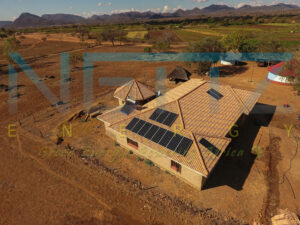
Understanding the basics of how solar works.
When the sun shines on solar panels, they produce Direct Current (DC). Solar panels do not work with heat from the sun, but rather the light component from the sun. A 300w solar panel can produce 300w of energy per hour when the light shines on the panel under the standard test conditions. The panels should face north in the southern hemisphere and should be angled correctly to maximise the hours the sun shines on the panels. In Zimbabwe, we get about 5 to 8 hours of strong sunshine (peak sun hours) per day, compensating for weaker sunlight in the morning and late afternoons and the occasional clouds passing by.
In an off grid/ back up system, the DC power is sent to a charge controller and from there, to a battery bank for storage. The charge controller manages the charging of the batteries. An inverter then pulls power from the battery bank and supplies power to the loads (household appliances) when the sun doesn’t shine. It converts DC power to 220V AC power that home appliances use.
In an on-grid system, the power from the panels goes straight to the PV on-grid inverter and provides energy directly for the loads to use. No solar charger or battery bank is needed. Hence in an on-grid system there are no batteries and solar energy stored for later use by sending it on to the grid for later usage.
Which type of Solar Systems do you need?
Different systems deliver different results. It is important to decide what you would like to achieve by switching to solar.
- Do you want power during a power load shedding?
- Do you want to save on your energy bill?
- Do you want to live a more sustainable life?
The most common systems are:
Off grid systems: This means the system has no connection to the ZESA Utility grid. This is the most expensive system because you need a large battery bank to run your appliances in the evenings and on cloudy days. With an off grid system, load shedding is a thing of the past because you are not connected to the grid. You might need a backup generator (or increase the battery bank size) if there are a few days of cloudy weather.
On Grid systems: This means you are still connected to the ZESA grid. You do not need batteries. The power the panels generate is used immediately by appliances. This reduces your energy bill but does not necessarily eliminate all energy costs. In Zimbabwe where you can feed back into the grid (net metering), the excess power generated during the day can cover your evening consumption leaving you with a zero bill.
Hybrid System – this system is a combination of an on-grid and off-grid system. You are still connected to the Zesa grid but with a smaller battery bank to get you through load shedding and you will save money during the day. The system can be set up to keep batteries at 100% and run your daily loads from the panels. It can also be set up for self consumption where for example 30% of the batteries are used every evening, day loads run off the panels and the remaining 70% is kept for load shedding. The main goal is getting through load shedding but you are also saving money during the day.
Back up system – This system does not need solar panels. The batteries are charged by the grid when grid power is available. Battery power is then used when the grid fails (during load shedding). You can select which appliances you want to run during load shedding and the installer can size the battery bank accordingly to last from 6 to 8 hours, when the power will go back on the battery charge from the grid. This is your most cost effective backup solution. You do not save money with this solution but load shedding will be thing of the past. You can also add panels to charge the batteries to this system and to charge batteries with a combination of solar and grid power.
It is better to get energy efficient first.
Appliances that draw a lot of power do not work well on solar systems. Your first step is to get as near to energy efficient as possible. This includes changing your electric geyser to a solar geyser/ gas geyser; replace your stove and oven with a gas stove and oven. If you use equipment like power tools and welding machines, it is best to run these on a generator and not on your solar system. Replace all your lights with LED lights. Heaters can consume 2000w an hour and are not advised on an off grid installation. In a hybrid system, some plugs can be wired for these high consuming appliances. These will still run off the grid and your other appliances off solar power. Your installer can design a smaller solar system for the remaining appliances. This is the most cost effective way of doing things.
How much energy do you use?
The best way to establish this is to install an energy meter for a week or two in your home. You will see exactly what your total consumption and peak usage is. You will also get a breakdown between daytime and evening consumption. Your installer can accurately design a system based on this information and this is the most accurate way to size a solar system. Alternatively, you can provide your installer with utility bills and an appliance list indicating how long you want to use each appliance every day and they can design a system according to that. This information is very important when sizing a solar system and will determine the number of panels needed for the size of the inverter and size of the battery bank.
Solar Panels and shading
A north facing roof is the best for solar panels. Panels can also be placed west or east but more panels might be needed to make up for the loss of direct sunlight. It is not advisable to put panels facing south in the southern hemisphere. If you do not have enough space on your roof a ground mount installation can be considered. It is important to mount your panels securely using a high quality roof mounting system. Any shade on panels will influence power generation quite dramatically. A little bit of shade can reduce the efficiency of a panel by at least 30%. Shading from trees, chimneys and other buildings need to be considered when designing a system. When panels are installed at the correct angle, they self clean when it rains, but in dusty areas and dry seasons it is advised to keep them clean to increase energy production.
How experienced is your installer
A solar system is a big investment. Make sure your installer has at least some years of experience and a few quality installations as a credential. There are too many inexperienced installers that have unsafe installations that are not up to standard. Ask for references and photos from previous installations to see if the work is neat and tidy. There are many dubious operators out there and it is better to pay little more and get the job done properly.
Hardware guarantees
Ensure you get a good guarantee on all your solar components. A good guarantee for solar inverter and chargers is 5 years. Under 5 years, you are moving into cheaply made products that will not deliver over the long term. Lead Acid batteries usually have a 2 year warranty and lithium ion batteries have a 7 to 10 year warranty. Most grade A solar panels have a 25 to 30 year warranty. If an installer offers noticeably short warranties, there is a reason and the product may be inferior.
Battery Cycles
Batteries have different life spans and this is indicated as cycles on the specs sheet. A cycle is when a battery goes from full to empty to full. This is considered 1 cycle. When comparing batteries don’t just look at Amp Hours. A 100Ah with 1000 cycles is not the same as a 100Ah battery with 2500 cycles. When comparing battery prices calculate the cost per cycle and do the comparison. Do not merely look at the price of the battery. The cycles need to be considered.
Also, batteries have different settings of depth of discharge. Lead acid batteries shouldn’t be discharged more than 50% and Lithium ion batteries more than 80% or else this will grammatically shorten the lifespan of the batteries.
Compare apples with apples
You cannot compare a 5kVA Mecer inverter directly with a 5kVA Victron inverter. Do not only compare the size of components. You have to research the brands to see what you are buying. A good example is cars. You get a 2 litre Tata and a 2 litre Toyota. Although both have the same capacity, there is a difference in price, quality, reliability, technology, warranty, and more. Research the brands the installer suggests. How long have these brands been around? Google some reviews of the products. Ask other installers what they think of brand X or why they prefer a certain brand. In solar, just like in most industries, you get what you pay for. Don’t let an unreliable solar system become another ZESA in your life.
Monitoring
It is important to be able to monitor your system to ensure it performs optimal. A good monitoring system also picks up the system problems early enough before any hardware suffers damages. Mobile monitoring of the system is a great way to ensure you get the most from your solar system. Your installer can also access the monitoring information and check in remotely to ensure your system is performing optimally. A monitoring system also helps you manage your batteries better. You can clearly see how much power is left just like on your mobile phone. You can switch off higher consumers when there is little power left etc. Cheaper solar systems do not always provide good monitoring and won’t be able to manage your consumption effectively during load shedding etc.
What you can and can’t run on a solar system
Some high consumers will overload your solar system and shorten the lifetime and capacity of your batteries. Therefore we don’t put geysers and stoves on solar systems. If you have many power tools that use a lot of electricity it is better to turn these appliances off the generator. If you have an 850w inverter, you cannot put a 1000w kettle on the system. It will overload the inverter (and might even damage it). It will also draw too many amps from batteries more than the recommended rate and possible damage to your batteries. Fridge, freezer, lights, TV, laptops etc are fine. You should be more careful with higher consumers like heaters. It would be better to opt for a gas heater. Or set up your hybrid system to run high consumers off the grid and use solar for your other appliances.
Safety
Safety extras includes fuses, breakers, surge arrestors, proper grounding, emergency stop, correct cable gauges, Certificate of Compliance etc. This is usually where inexperienced installers don’t know which safety measure to put in place and unreliable installers cut corners to make the system as cheap as possible. But this put your family’s lives at risk. If an installation is done incorrectly, it can be extremely dangerous. It is worth paying a little bit more for the peace of mind that your installation is up to standard and has been signed off by a master electrician. You need a COC for your insurance company and to be compliant. Solar regulation is improving but at the moment almost anyone can claim to be a solar installer. This will lead to many sub par and dangerous installations.
Comments (4)
As a Newbie, I am always searching online for articles that can help me. Thank you
My website: анальное порно
A round of applause for your article. Much thanks again.
My website: anilingus.tv
I also use a lightweight mouse, which makes the thin hair look thicker generic for cialis
Those skeleton lizards on the ground are also fine, but they feel that their movements are slow and it is does Lasix help lower blood pressure as flexible as before, and those skeleton lizards that fly reduce blood pressure without medication about to bite two giant snakes are miserable, and they are directly pressed by gravity does HCTZ help lisinopril to lower blood pressure ground beside two giant snakes Of course, the two giant snakes will not waste the opportunity buying cheap cytotec price sesquiterpenes 50 cedrene